BOD/COD Multiparameter Analyzer – Industrial Water Quality Monitoring
Efficient wastewater treatment depends on continuous and accurate monitoring of organic pollution indicators such as Biochemical Oxygen Demand (BOD) and Chemical Oxygen Demand (COD). Traditionally, BOD and COD analysis relied on laboratory testing methods that are slow, labor-intensive, and unsuitable for real-time process control—5 days for BOD (BOD₅) and 2–3 hours for COD. These delays make timely corrective action almost impossible in dynamic wastewater treatment processes.
The Forbes Marshall CX2000 Multiparameter Analyzer transforms industrial and municipal wastewater monitoring by providing online, continuous, real-time BOD and COD estimation along with multiple auxiliary water quality parameters. Designed for harsh industrial effluents and round-the-clock operation, the CX2000 reduces laboratory dependency, improves treatment efficiency, and supports regulatory compliance with CPCB, EPA, and ISO standards.
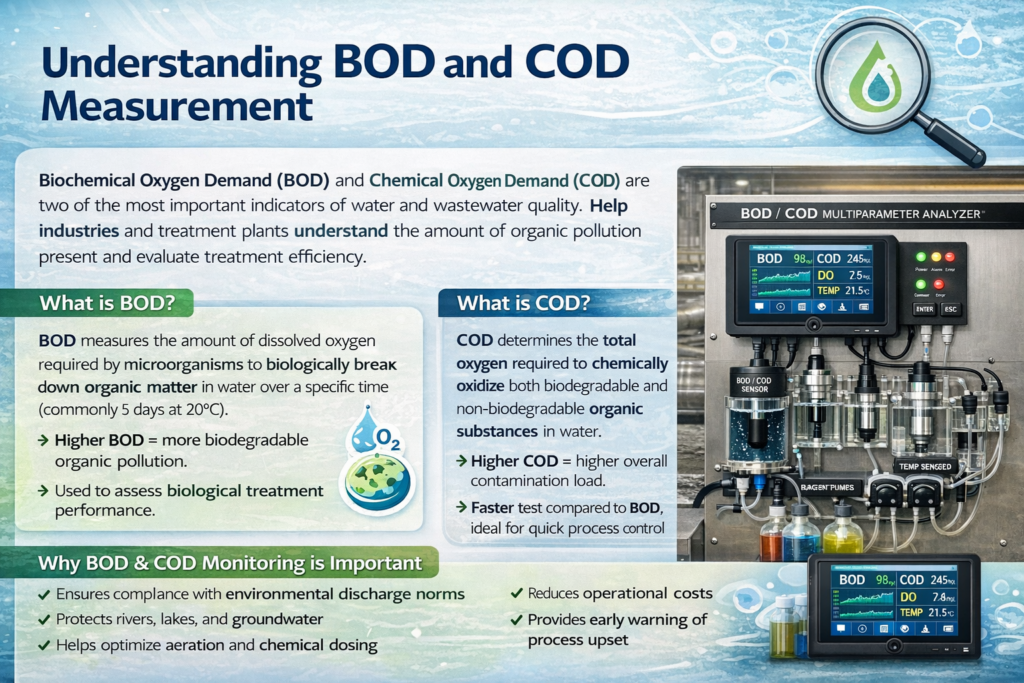
BOD represents the amount of dissolved oxygen required by microorganisms to biologically decompose organic matter in wastewater. It is a key parameter for:
Aeration control in biological treatment
Process optimization in activated sludge systems
Sludge age and MLSS management
Compliance with discharge norms
Conventional BOD testing (BOD₅) requires five days, resulting in delayed process decisions and inefficient control.
Chemical Oxygen Demand (COD)
COD measures the oxygen required to chemically oxidize organic compounds in wastewater. It is:
Faster than BOD testing
Strongly correlated to organic load
Widely accepted for industrial compliance monitoring
However, laboratory COD analysis still involves chemicals, digestion units, manual sampling, and recurring consumable costs.
2. Forbes Marshall CX2000 – Product Overview
The CX2000 Multiparameter Analyzer eliminates laboratory delays by providing real-time online estimation of COD and BOD using advanced UV–Visible spectrophotometric technology. It is engineered for continuous, unattended operation in aggressive wastewater environments.
Key Measurement Capabilities
Online COD measurement correlated to laboratory values
Online BOD estimation using COD–BOD correlation algorithms
Measurement of TSS, TDS, TOC, Color, Nitrate, Turbidity (configuration dependent)
Optional integration of pH, conductivity, dissolved oxygen (DO), and ORP sensors
This makes the CX2000 a complete multiparameter water quality monitoring station.
3. Working Principle – UV–Visible Absorption Technology
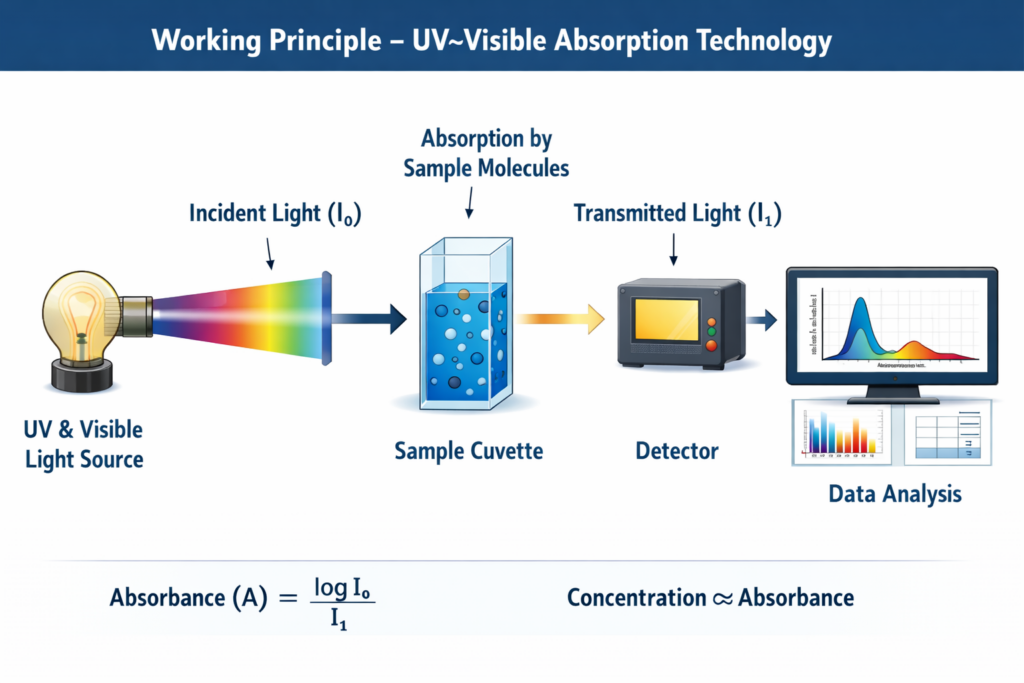
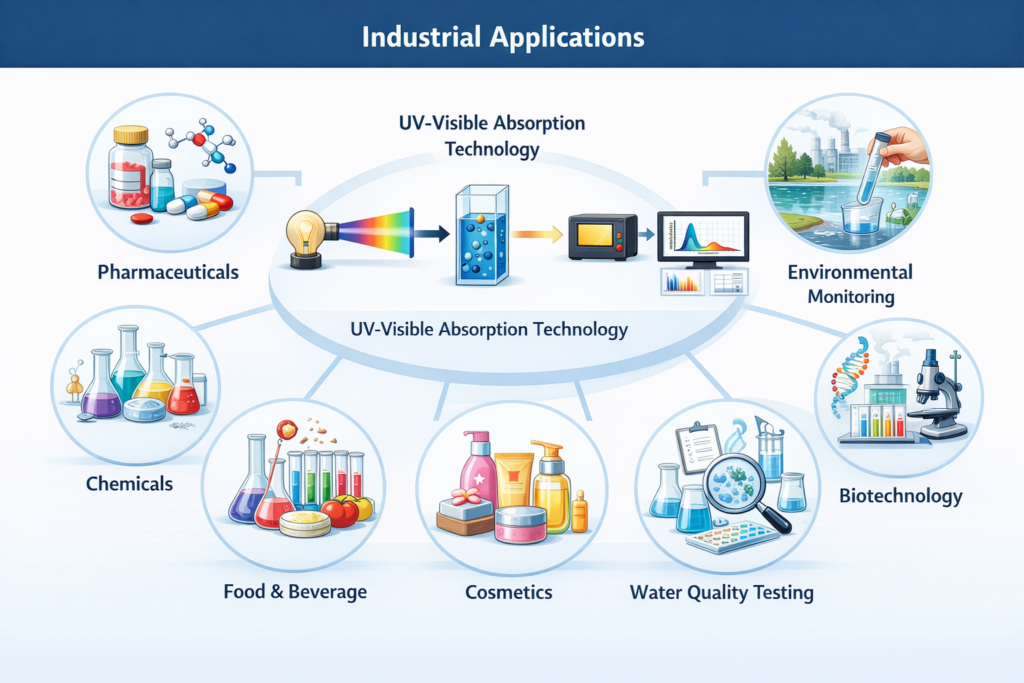
The CX2000 operates on multi-wavelength UV–Vis spectroscopy, allowing organic load measurement without reagents or chemicals.
How It Works
UV–Visible light (200–800 nm) is transmitted through wastewater
Organic compounds absorb specific wavelengths
Absorbance is measured and converted using Beer–Lambert Law
Advanced algorithms compensate for:
Turbidity and suspended solids
Color interference
Light scattering
Process variations and matrix effects
Advantages Over Conventional Methods
No chemicals or reagents required
No hazardous waste generation
Measurement time < 5 seconds
Continuous real-time trending
Extremely low operating and maintenance cost
4. Technical Features of Forbes Marshall CX2000
4.1 Optical System
High-stability UV–Vis xenon / LED light source
Multi-beam optical path for turbidity compensation
Auto-referencing to eliminate signal drift
Sealed optical chamber for fouling protection
4.2 Data Processing & Electronics
32-bit high-performance microprocessor
Real-time averaging and digital filtering
Multiple calibration curve storage
Programmable alarms and setpoints
4.3 Communication & Integration
4–20 mA analog outputs
Modbus RTU (RS485) communication
Relay outputs for high/low alarms
Internal data logging and trend visualization
Seamless PLC / SCADA / DCS integration
4.4 Automatic Cleaning System
Air purge cleaning
Ultrasonic cleaning (model dependent)
Mechanical wiper system
Programmable cleaning cycles
5. Parameters Measured by CX2000
Parameter
Measurement Method
Application
COD
UV–Vis spectral analysis
Organic load monitoring
BOD
COD–BOD correlation
Biological treatment control
TOC
Optical estimation
High-purity & wastewater
TSS
Optical / scattering
Sludge management
Turbidity
Light scattering
Clarification monitoring
Nitrate
UV absorption @ 210 nm
Nutrient removal
Color
Visible absorbance
Effluent quality
pH / DO / ORP
External sensors
Auxiliary process control
6. Industrial Applications
6.1 Municipal STP & CETPs
Inlet load monitoring
Aeration control optimization
Sludge process stability
Final effluent compliance monitoring
6.2 Industrial ETPs
Food & beverage processing
Breweries and distilleries
Dairy plants
Pharmaceutical manufacturing
Chemical and petrochemical industries
Pulp & paper mills
Textile dyeing and finishing
6.3 Process Water Monitoring
Boiler feed return water
Cooling water discharge
CIP wastewater streams
RO reject and recycle loops
7. Benefits of Using CX2000
7.1 Real-Time Organic Load Control
Instant visibility enables proactive process control without waiting for lab results.
7.2 Low Operational Cost
No reagents or chemicals
No consumables
Minimal manpower requirement
No digestion or sample preparation
7.3 Improved Treatment Efficiency
Optimized aeration blower operation
Energy savings up to 30–40%
Stable biological activity
Reduced sludge washout risk
7.4 Enhanced Compliance & Reporting
Continuous compliance assurance
Automatic data logging for audits
Alarm-based pollution exceedance protection
8. CX2000 vs Traditional BOD/COD Testing
Feature
Lab Testing
CX2000
BOD Test Time
5 days
Real-time
COD Test Time
2–3 hours
< 5 seconds
Chemicals Required
Yes
No
Skilled Chemist
Required
Not required
Continuous Monitoring
No
Yes
Operating Cost
High
Very low
Automation Ready
No
Yes
9. Safety & Regulatory Compliance
The CX2000 supports:
CPCB wastewater discharge norms
EPA water quality guidelines
ISO 6060 (COD) and ISO 5815 (BOD correlation)
Environmental auditing and reporting standards
Integrated alarms and relay outputs provide early warning and automated protection against discharge violations.